Case study
QuoteKamili
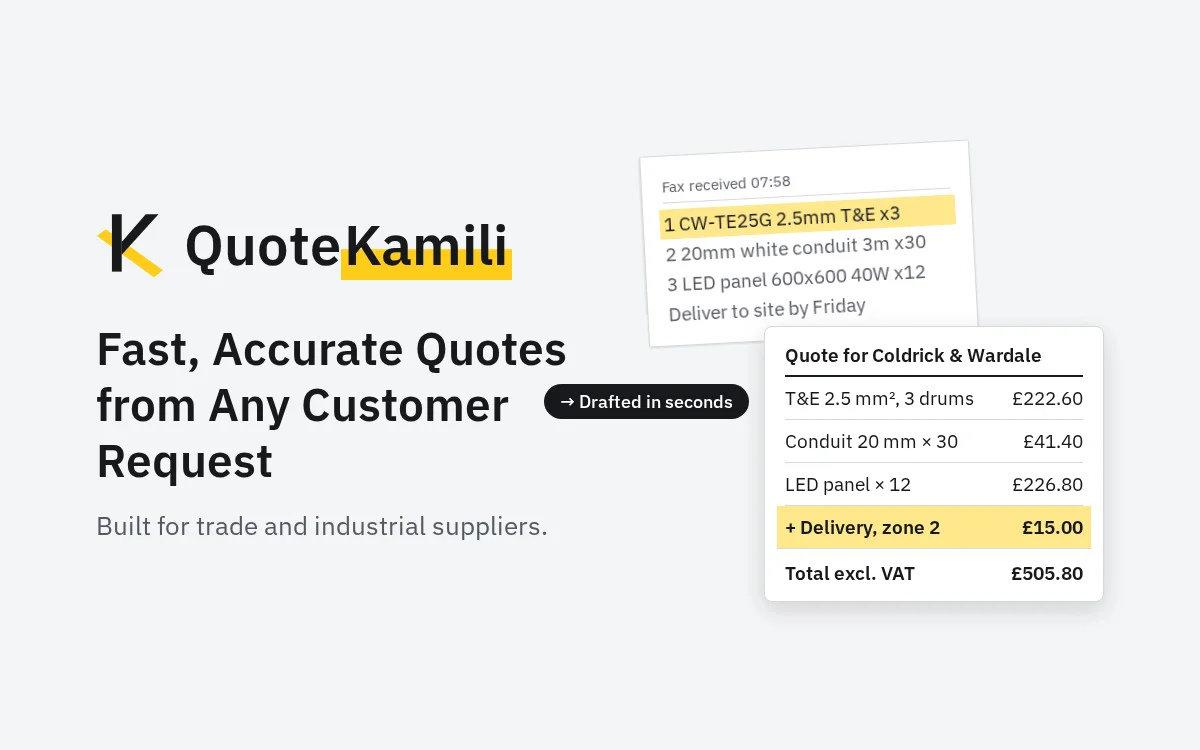
Quote requests in any format become complete, priced quotes in under a minute, and every price is calculated in tested code rather than by the model.
- Role
- Founder & Lead Engineer
- Dates
- Sep 2026 – Present
- Stack
- TypeScript
- React
- Node.js
- PostgreSQL
- pgvector
- AWS ECS Fargate
- AWS RDS
- AWS CDK
- Capacitor
- Tauri
- Vitest
- Playwright
- fast-check
- axe-core
The problem
Trade and industrial suppliers in the UK, Ireland and the US, from electrical and plumbing to building materials and metals, get requests for quotes in every format: emails, PDFs, faxes, scans, spreadsheets, photos of handwritten lists, bills of quantities. Turning each one into a priced quote means hours of retyping lines, looking them up in the supplier's catalogue, and remembering the delivery or cutting charge.
The obvious shortcut is to hand the whole request to a language model. But a quote is a commitment to a price. A model that misreads a unit or miscounts a total, or that sees a supplier's pricing, is a risk a supplier can't take.
What I built
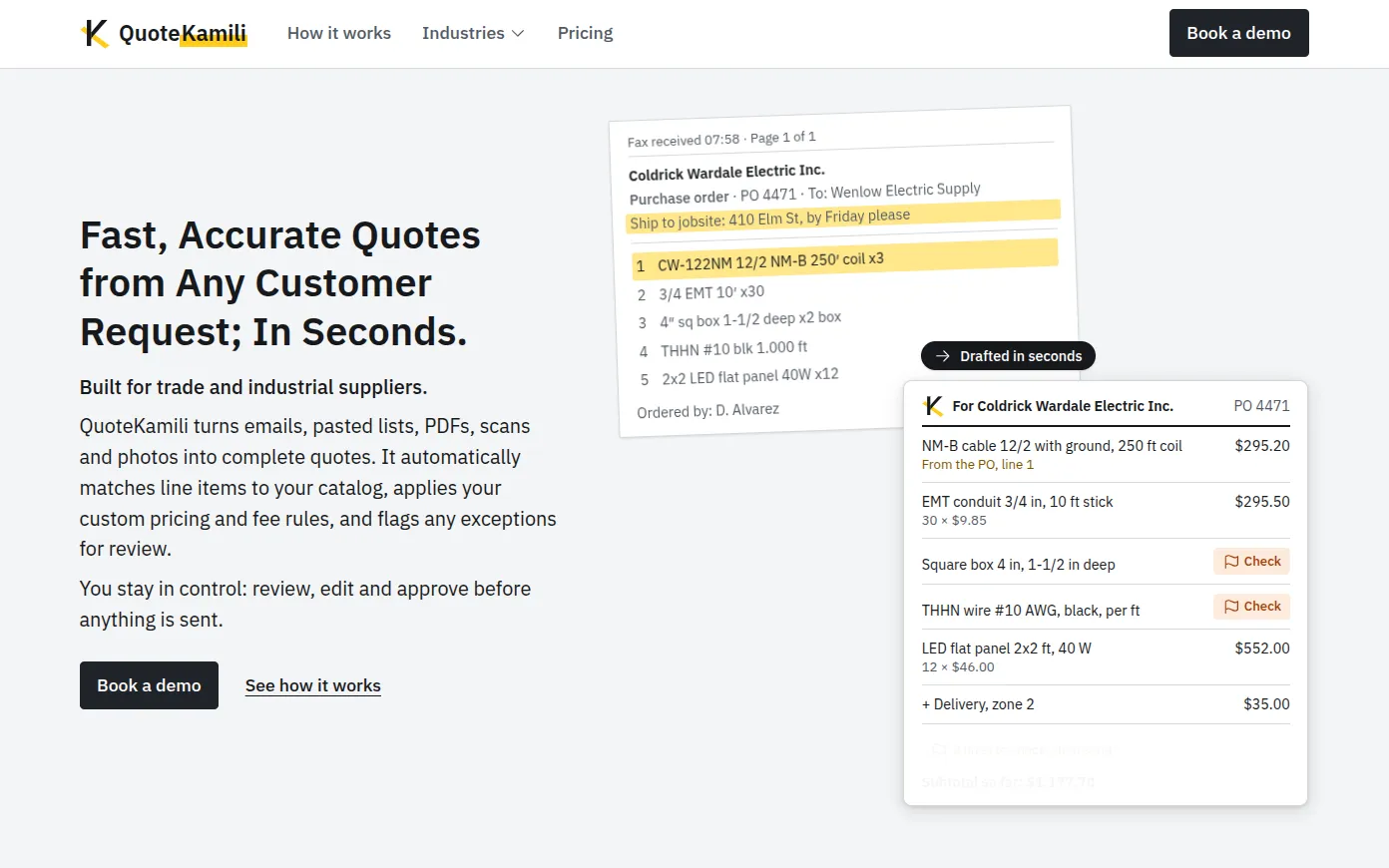
- An AI pipeline that reads requests in any format (emails, PDFs, faxes, scans, spreadsheets, photos of handwritten lists, bills of quantities, several purchase orders in one file) and matches each line to the supplier's catalogue, including customers' own part numbers. Correct one once, and it sticks.
- Pricing in tested code. Prices, totals, unit conversions and fees such as delivery, cutting and minimum-order charges come from the supplier's own price lists and fee rules, never from the model, and supplier pricing is never sent to one. Missing fees and prices that differ from a contract or list are flagged.
- Source tracing and review. Every quote line links to its place in the source document, and a rep approves each quote before it goes to a customer or the ERP.
- Sending and export. An approved quote goes out as a branded PDF from the supplier's own email, phone or WhatsApp, with a notice when the customer opens it, or as an import file for their ERP.
- Safe handling of customer documents. Text inside a document is treated as content, never as instructions, and every file is checked for malware and opened in isolation. Customer data never trains AI models, the service that reads requests keeps nothing afterwards, and data is stored and read in EU data centres, encrypted in transit and at rest.
- A multi-tenant platform on AWS (ECS Fargate, RDS PostgreSQL with pgvector, CDK) with row-level security in the database.
- Idempotent background jobs, so a retry never creates a duplicate quote or charge.
- Property-based tests (fast-check) on pricing and credit rules, and UI tests in real Chromium, WebKit and Firefox across time zones with Vitest, Playwright and axe-core.
- One React codebase, shipped to web, to iOS and Android through Capacitor, and to desktop through Tauri.
How it works
Key decisions
The model reads; code prices
Instead ofLetting the model produce prices and totals
The model only extracts what the customer asked for. Prices, fees, totals and unit conversions run in code covered by property-based tests, so the same request always gets the same price, and supplier pricing is never sent to a model.
A person approves every quote
Instead ofSending quotes out automatically when extraction looks confident
Every quote line links to its place in the source document, so a rep can check each line against what the customer actually wrote. Nothing reaches a customer or the ERP until a rep approves it.
Document text is content, not instructions
Instead ofPassing a document's text to the model as if it were part of the prompt
Customers' documents can contain anything, including text written to steer a model. QuoteKamili treats everything inside a document as content to read, never as instructions, and opens each file in isolation after a malware check. With prices outside the model's reach and a rep approving every quote, a hostile document can't change what a customer is charged.
Tenant isolation in the database
Instead ofFiltering by tenant in application code only
A supplier's catalogue and pricing are the most sensitive data in the system. Row-level security in PostgreSQL enforces isolation in the database itself, so one missed filter in application code can't expose another tenant's data.
Idempotent background jobs
Instead ofAssuming each job runs exactly once
Background jobs get retried after timeouts and failures. Every job is idempotent, so a retry never creates a duplicate quote or charge.
Results
Requests that took hours of retyping become complete, priced quotes in under a minute. Every price and fee comes from tested code, every line can be traced back to the customer's document, and nothing goes out without a rep's approval.
Screenshots